
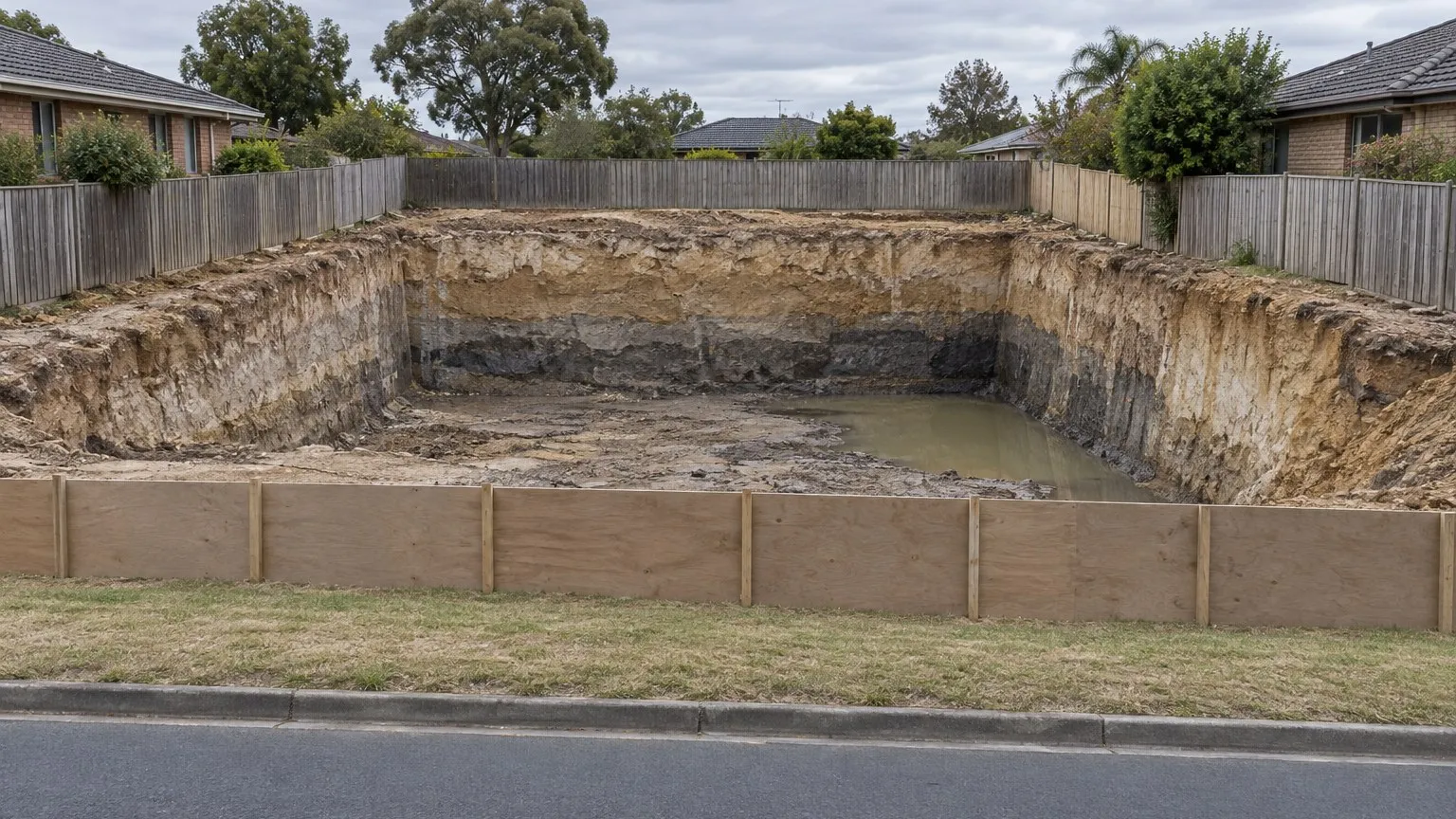
You find a site with a real story: a sloping block a few streets from the water, room for the homes the numbers need, and a design your planner likes. Then the geotechnical report comes back with groundwater at two metres and the designer starts talking about a drained basement or a deeper footing system.
That is usually treated as a construction problem. In New South Wales it is also a water licensing problem, and it can stop the site before anyone lifts a spade.
The deal question: will your dig take water from a water source?
NSW Water's page on managing groundwater in NSW identifies which activities fall within the scope of aquifer interference, and construction dewatering for buildings, transport projects or civil works is named among the high risk activities. An aquifer interference activity is described there as an activity that penetrates an aquifer, interferes with groundwater in an aquifer, changes or obstructs groundwater flow in an aquifer, takes groundwater from an aquifer, or disposes of water taken from an aquifer.
So the feasibility question is not "is there water in the hole". It is this: does the excavation or the ongoing drainage of the finished structure take water from a water source, and how much?
The trap: development consent is not permission to take groundwater
This is the misconception that causes the damage, and it is worth reading the department's own words. The minimum requirements for building site groundwater investigations and reporting states that developers, or their agents, must seek appropriate licences and approvals for a building project before construction starts, and that the licensing of a volume of water is independent of the planning process, even in integrated or state significant development. It then states plainly that developers should be aware that getting development consent does not automatically include permission to take groundwater.
Read that against a normal consent. Your conditions of consent may require a dewatering management plan, and that plan may read as though it authorises the take. It does not. The plan is one document in a separate licensing pathway.
What actually needs to be obtained
The departmental page records that works used in the taking of groundwater by an aquifer interference activity need an approval unless an exemption applies, and lists the possibilities as one or more of a water access licence, a water supply work approval, a water use approval or a controlled activity approval. It also records that aquifer interference activity approvals are not available at this time, which is why the pathway in practice runs through the other instruments rather than the one named after the activity.
The NSW Aquifer Interference Policy explains why the volume matters even when the water is never used. It records that water is taken incidentally where the take is required to allow the effective and safe operation of the activity, giving dewatering to allow mining or coal seam gas extraction as the example, and that in all cases the activity is taking water from a water source. It also states that dewatering of groundwater during building construction requires a water licence unless an exemption applies, even where that water is not being used consumptively.
The exemption that saves some sites, and what it does not cover
There is a genuine and useful exemption. The dewatering exemptions page states that a dewatering licence exemption applies if you take 3 megalitres or less of groundwater per year from any water source, and describes a separate exemption for groundwater taken in connection with the construction of buildings and infrastructure in designated coastal areas, where the construction occurs within the coastal water sharing plan areas and all water taken is recorded and reported.
The page then puts the boundary around it. It states that these exemptions only apply to water access licences, and that even if you are eligible for an exemption from a water access licence you must still obtain any other relevant approvals, such as a water supply work approval.
Three megalitres is not a large allowance on a deep dig with a long programme. The exemption is a screening question at feasibility, not a conclusion.
The no more than minimal harm test shapes your design
The same departmental material and the minimum requirements document both turn on the no more than minimal harm test. The minimum requirements document states that approvals can only be granted if the approval body is satisfied that no more than minimal harm will result, and that where insufficient site-specific evidence is provided to characterise the ground and groundwater conditions beneath the property, the department may not be able to determine that no more than minimal harm will result. It states the department will adopt a precautionary approach in those cases and require the take of groundwater to be limited to the building construction period only, and that applications for drained basements that cannot demonstrate no more than minimal harm will not be supported without further detailed information.
That is a design instruction disguised as a regulatory test. A tanked basement that keeps groundwater out permanently is a different application from a drained basement that pumps for the life of the building, and the difference is decided by the groundwater evidence you commission early.
The site test a student would run, in order
- Check the depth to groundwater on the geotechnical and hydrogeological evidence, not on the architect's assumption about footing depth.
- Decide whether the design takes groundwater. Any excavation receiving inflows or seepage, and any basement that is drained rather than tanked, is a candidate.
- Estimate the volume the excavation and the construction period will take, and compare it with the exemption thresholds.
- Screen the exemption position. Volume alone is not enough; the work approval question survives the licence exemption.
- Check whether the work is on waterfront land or otherwise needs a separate water approval, because the same framework governs controlled activities near waterways.
- Price the licence, the investigation reports, the dewatering management plan and the monitoring into the feasibility as a line item, with contingency.
- Start the enquiry before the development application is lodged, which is what the department recommends.
What this does to the offer
Run the feasibility twice: the basement design you want, and a shallow design that stays above the watertable. If the second version is materially more profitable once the water approvals, reports, pumping, treatment and monitoring are costed, then the water is the deal, and your offer should reflect the cost of the first version rather than the optimism of the second.
Also test a timing shock. If the licence takes months rather than weeks, what happens to your holding costs, your builder's programme and your presale obligations? An approval that arrives after the machine is booked is a delay you are paying for twice.
Practical next steps
You are not expected to solve this yourself. A geotechnical engineer or hydrogeologist characterises the ground and the groundwater beneath the site and defines the volume of take. A town planner confirms how the water approval sits inside the development application and whether the proposal is integrated development. A water licensing consultant, or the department's own water licensing team, confirms which authorisations are required for this site and which exemptions genuinely apply. Confirm the current in-force Act text, policy and exemption position before you commit to a basement, a programme or a price.
Sources and boundaries
Sources checked 28 September 2026. Jurisdiction and limits: New South Wales specific information. This guide relies on the Water Management Act 2000 (NSW), the NSW Aquifer Interference Policy, the department's minimum requirements for building site groundwater investigations and reporting, and the published dewatering exemption material. The copy of the Act used here is the compiled text as at 1 July 2023, and the departmental policy pages carry their own update dates, so the current in-force version must be confirmed. Whether an activity is an aquifer interference activity, whether a licence is required, whether an exemption applies at the volumes involved, and what approvals are needed are all site specific and depend on the aquifer, the water sharing plan, the volume and duration of the take and the design of the work. The aquifer interference activity approval is recorded on the current departmental page as not currently available, so the authorisation pathway may be a water access licence, a water supply work approval, a water use approval or a controlled activity approval, or a combination. Other states and territories must not be assessed against this material. This is general information only.
- NSW Water — Managing groundwater in NSW. Used for: the statement that the Water Management Act 2000 identifies the scope of aquifer interference activities; the listed high risk aquifer interference activities including construction dewatering for buildings, transport projects and civil works; that works used in the taking of groundwater by an aquifer interference activity need an approval unless an exemption applies; and that aquifer interference activity approvals are recorded as not available at this time (Checked 28 September 2026)
- NSW Water — Dewatering exemptions. Used for: the 3 megalitres or less groundwater dewatering licence exemption; the coastal construction licence exemption; that these exemptions apply only to water access licences; and that a water supply work approval or other relevant approval may still be required even where a licence exemption applies (Checked 28 September 2026)
- NSW Aquifer Interference Policy (PDF). Used for: the definition of an aquifer interference activity; that the policy is to be applied to the licensing and assessment of those activities; the minimal harm test; and that water taken incidentally by dewatering during building construction requires a water licence unless an exemption applies (Checked 28 September 2026)
- Minimum requirements for building site groundwater investigations and reporting (PDF). Used for: that excavation for building basements receiving groundwater inflows or seepage is an aquifer interference activity; that developers or their agents must seek appropriate licences and approvals before construction starts; that development consent does not automatically include permission to take groundwater; and the no more than minimal harm test applied to drained basement applications (Checked 28 September 2026)
- Water Management Act 2000 (NSW) — compiled text as at 1 July 2023 (PDF copy). Used for: the activity approval provisions, including the controlled activity and aquifer interference activity offence provisions, and the definition of waterfront land used elsewhere in the water approval framework (Checked 28 September 2026)
This article is general education, not personalised planning, legal, financial, tax, privacy, safety or building advice. Requirements and outcomes vary by jurisdiction, site, contract, structure and circumstances. Check current information with the relevant authority and appropriately qualified advisers.
 Learn with Jason & AmyBuild practical small-scale property development skills with experienced mentors.Enquire now
Rate this article
Guest rating: select 1 star for poor or 5 stars for great. No account is required.
Leave a comment
Join the discussion. Your email address will not be published.
Frequently asked questions
Why is dewatering a licensing issue rather than just a site cost?
Because NSW treats the groundwater you remove as water taken from a water source. The current departmental page on managing groundwater in NSW identifies construction dewatering for buildings, transport projects or civil works as a high risk aquifer interference activity, and records that works used in the taking of groundwater by an aquifer interference activity need an approval unless an exemption applies. The authorisations can be one or more of a water access licence, a water supply work approval, a water use approval or a controlled activity approval. Deploying a pump is the visible action; the licence obligation sits behind it.
Does my development consent cover the water take?
No, and this is the most common misunderstanding. The department's minimum requirements document for building site groundwater investigations and reporting states that developers, or their agents, must seek appropriate licences and approvals for a building project before construction starts, and that the licensing of a volume of water is independent of the planning process even in integrated or state significant development. The same document states plainly that developers should be aware that getting development consent does not automatically include permission to take groundwater.
Is there an exemption if I only take a small volume?
There can be, and the threshold is published. The dewatering exemptions page states that a dewatering licence exemption applies if you take 3 megalitres or less of groundwater per year from any water source, in the circumstances described there, and there is a separate exemption for groundwater taken in connection with the construction of buildings and infrastructure in designated coastal areas, subject to conditions including recording and reporting. Critically, the same page states that these exemptions only apply to water access licences, and that even if you are eligible for a licence exemption you must still obtain any other relevant approvals, such as a water supply work approval.
What does the no more than minimal harm test actually mean for my design?
It is the test the decision maker applies, and it is evidenced by investigation rather than asserted. The minimum requirements document states that approvals can only be granted if the approval body is satisfied that no more than minimal harm will result from the activity or work, that where insufficient site-specific evidence is provided to characterise the ground and groundwater conditions the department may not be able to determine that no more than minimal harm will result, and that the department will adopt a precautionary approach and limit the take to the construction period only. It also records that applications for drained basements that cannot demonstrate no more than minimal harm will not be supported without further detailed information.
When should this work start relative to the development application?
Earlier than most people plan for. The department recommends that enquiries about licences and approvals begin between the developer and the relevant agency before the development application is lodged, because that maximises the time available to obtain the authorisation before the planned construction start. Informed groundwater assessments that properly define the volume of take are described as helping prevent delays that could occur if construction were stopped by unforeseen inflows. That means the groundwater investigation is a due diligence item, not a construction item.
Loading comments…