
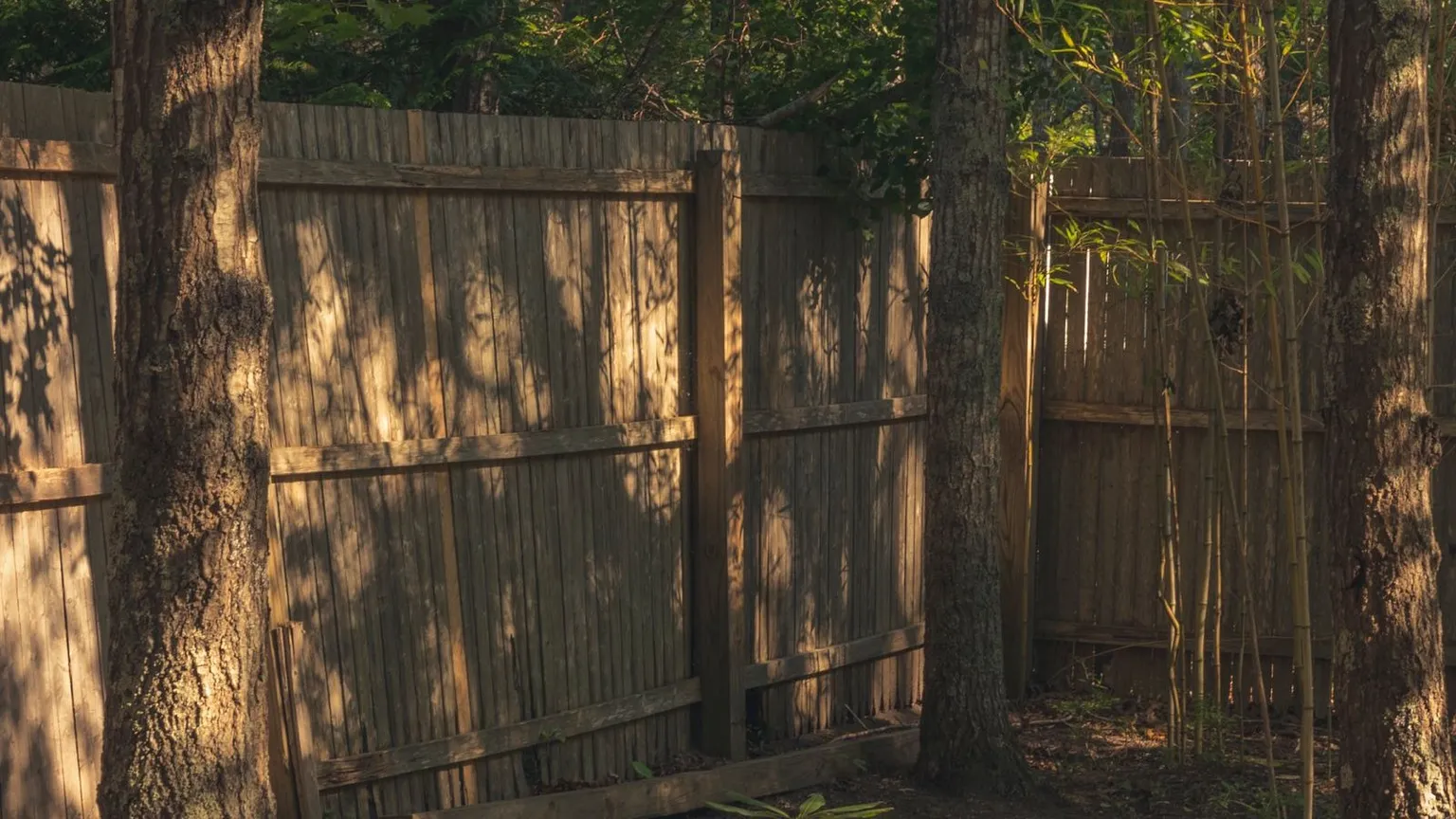
A subdivision or a rebuild almost always disturbs a boundary fence, and the fence is the one line item in the budget that a neighbour can stop. I have watched developers price a demolition, a new slab and a landscaping allowance, then discover that the paling fence they planned to remove is shared property under the Dividing Fences Act 1991 and cannot simply be taken down and replaced at will.
Here is the practical version. In New South Wales the Act governs how the cost of a dividing fence is shared, what a fencing notice must contain and how a dispute is resolved. If you understand that process before you exchange, a fence becomes a priced, scheduled item. If you do not, it becomes a delay with a neighbour attached to it.
The deal question: is the fence on the boundary you are about to change?
Start with the survey, not the fence. Under NSW law, if your land is Torrens title the exact boundaries are shown on the deposited plan held by NSW Land Registry Services, and if the plan does not resolve a dispute you can have a survey carried out by a registered surveyor, or apply to the Registrar-General under Part 14A of the Real Property Act 1900 for a boundary determination. Old fences frequently sit off the legal line, and a fence you demolish believing it is yours may in fact be a dividing fence that the Act protects.
The Act's own definition is broad. A dividing fence separates the land of adjoining owners whether or not it sits on the common boundary, and it can be a structure, a ditch, an embankment, or a hedge or similar vegetative barrier. It includes gates and the foundations or supports necessary for the fence, but it does not include a wall that is part of a house, garage or other building, and a retaining wall counts only where it supports the fence. That last distinction matters on sloping sites, where a retaining structure and a fence are often built as one element and treated as two.
What a fencing notice has to say, and when you must serve it
If you want a contribution, you must serve a fencing notice first. The State Library's summary of the Act sets out the required contents: the notice must specify the boundary line, or the line of the proposed fence if the common boundary is impracticable, the type of fencing work proposed, the estimated cost, and if the cost is not to be shared equally, the share proposed. A tenant can only be served where the unexpired term of the tenancy at the time of issuing the notice is five years or more, so in a normal residential setting you serve the owner.
Then the clock runs. If the parties cannot agree, the summary records that they can attend mediation at a Community Justice Centre, or, after one month has elapsed, either party can apply to the Local Court or to the NSW Civil and Administrative Tribunal for an order. Wollondilly Shire Council's dividing fences page states the same sequence: a notice must be served before seeking a contribution, and if agreement is not reached within one month of service either owner may apply to have the matter decided.
Put that month in your program. A fencing notice served the week before demolition is not a strategy; it is a schedule risk you created yourself.
Who pays, and the three exceptions that catch developers
The starting point is equal contribution to a sufficient dividing fence, which the Land and Property Management Authority pamphlet reproduced by Strathfield Council describes as a fence that adequately separates the properties, such as a paling fence in a residential area. Three exceptions matter to a development budget.
- You want a better fence, you pay the difference. The pamphlet records that an owner must pay the additional cost if they want a fence of a higher standard than is required for a sufficient dividing fence. If your project needs an acoustic or Colorbond barrier and the neighbour is content with palings, price the gap yourself.
- Damage is on the person who caused it. An owner pays the full cost if the existing fence is damaged, deliberately or negligently, by them or by someone else with their permission. On a demolition or excavation job that includes your contractors, so your builder's site management is a cost control here as well as a safety control.
- Public authorities do not contribute. The pamphlet and Wollondilly's page both state that public authorities with control over Crown lands, parks, reserves and roads do not have to contribute to fencing costs, though you can still negotiate with them.
There is also a pooling clause that catches projects retaining an existing pool: the State Library records that where the fencing work includes special requirements for enclosing a swimming pool under the Swimming Pools Act 1992, those extra expenses must be met by the owner of the property that contains the pool. On a subdivision where you keep the house and its pool, that is your line item. If the pool barrier itself needs work, Griffith City Council's certificate of compliance application form reproduces section 22D of the Swimming Pools Act 1992, including that a certificate of compliance remains valid for a period of 3 years from the date on which it is issued, and that the pool must be registered under Part 3A.
The trap
The expensive mistake is doing the work first and seeking the contribution afterwards. The Strathfield pamphlet states it plainly: an owner who goes ahead and builds a new fence without consulting the adjoining owner, before either coming to an agreement or seeking an order, has no grounds under the Act for recovering the cost. Demolition contractors move fast, and a fence can be gone before anyone has read the notice. Instruct your builder in writing that the boundary fence is not to be removed until you confirm the fencing position.
What this means for feasibility and timing
In your feasibility, carry the fence as three separate numbers rather than one: the survey cost, the full cost of a sufficient fence, and the premium for the standard you actually want. Then carry a program allowance of at least the statutory notice period, plus time for inspection and any mediation. If the neighbour is unknown, overseas, or the adjoining land is a public reserve, treat the fence as a longer-lead item and check the Act's service and urgent-work provisions with your lawyer.
You are not expected to solve this yourself. This is a legal process with a defined notice and a defined dispute path, and the right next step is to brief a property lawyer who practises in NSW, with a registered surveyor engaged to fix the boundary, before you serve anything or demolish anything. Ask them to confirm the adjoining owner, the required notice contents, the standard that applies in this locality, and how cost will be shared. They do the assessment. You schedule the work.
Sources and boundaries
Sources checked 2 October 2026. Jurisdiction and limits: The Dividing Fences Act 1991 (NSW) as published by the State Library of NSW Find Legal Answers service and the Land and Property Management Authority pamphlet reproduced by Strathfield Council, plus Wollondilly Shire Council's dividing fences page and Griffith City Council's swimming pool certificate material for the pool clause. Fencing law in other states and territories, council fencing policies applying to a particular site, and the position of any individual adjoining owner are outside this article.
- State Library of NSW Find Legal Answers — Dividing fences. Used for: The Dividing Fences Act 1991 procedure: what a fencing notice must specify under section 11, the one-month period before applying to the Local Court or NCAT, the equal-contribution principle, and the clause that the owner of a property containing a pool meets extra enclosure costs (Checked 2 October 2026)
- Strathfield Council — Dividing fences law pamphlet (Land and Property Management Authority). Used for: The higher-standard cost rule, liability for deliberate or negligent damage, that public authorities with control of Crown lands, parks, reserves and roads do not contribute, and that an owner who builds without consulting has no grounds under the Act for recovering cost (retrieved through the browser; the server returns 403 to plain curl) (Checked 2 October 2026)
- Wollondilly Shire Council — Dividing fences. Used for: That a fencing notice must be served before seeking a contribution, and that if agreement is not reached within one month of service either owner may apply to a Local Court or Local Land Board (Checked 2 October 2026)
- State Library of NSW Find Legal Answers — Boundaries. Used for: That Torrens title boundaries appear on the deposited plan held by NSW Land Registry Services, and the Part 14A Real Property Act 1900 boundary determination application to the Registrar-General (Checked 2 October 2026)
- Griffith City Council — Application for certificate of compliance for swimming pool (SD-FO-237). Used for: Reproduces section 22D of the Swimming Pools Act 1992, including that a certificate of compliance remains valid for 3 years from the date on which it is issued and that the pool must be registered under Part 3A (retrieved through the browser; the server returns 403 to plain curl) (Checked 2 October 2026)
This article is general education, not personalised planning, legal, financial, tax or building advice. Requirements and outcomes vary by jurisdiction, site, contract, structure and circumstances. Check current information with the relevant authority and appropriately qualified advisers.
 Learn with Jason & AmyBuild practical small-scale property development skills with experienced mentors.Enquire now
Rate this article
Guest rating: select 1 star for poor or 5 stars for great. No account is required.
Leave a comment
Join the discussion. Your email address will not be published.
Frequently asked questions
Do I have to tell my neighbour before I remove an old boundary fence in NSW?
Yes, if you want them to contribute. The State Library's summary of the Dividing Fences Act 1991 states that the procedure to require a neighbour to contribute is to issue a fencing notice containing the details of the proposed work. The Strathfield pamphlet adds that an owner who goes ahead and builds a new fence without consulting the adjoining owner, before either coming to an agreement or seeking an order, has no grounds under the Act for recovering the cost.
What exactly must a fencing notice contain?
The State Library records that there is no standard format, but section 11 of the Act requires the notice to specify the boundary line or, if impracticable, the line of the proposed fence, the type of fencing work proposed, the estimated cost, and, if the cost is not to be equally shared, the share proposed. Confirm the exact wording and service method with a NSW property lawyer.
How long before I can escalate a fence dispute?
The State Library's summary states that if the parties cannot agree they can attend mediation at a Community Justice Centre or, after a month has elapsed, either party can apply to the Local Court or to the NSW Civil and Administrative Tribunal for an order. Wollondilly Shire Council's page describes the same one-month period running from service of the notice.
The neighbour wants a cheaper fence than my project needs. Who pays?
The Land and Property Management Authority pamphlet reproduced by Strathfield Council states that an owner must pay the additional cost if they want a fence of a higher standard than is required for a sufficient dividing fence. So the cost is shared to the sufficient-fence standard and you carry the premium above it. What counts as sufficient for the locality is a question for your lawyer, and in a dispute the Act lists the factors a court considers.
There is a pool on my block and the fence encloses it. Does that change anything?
It can. The State Library's summary of the Act records that where fencing work includes special requirements for enclosing a swimming pool under the Swimming Pools Act 1992, those extra expenses must be met by the owner of the property that contains the pool. On a subdivision where you retain the existing dwelling and its pool, budget that separately rather than assuming an equal split.
Photo: Pexels, free to use under the Pexels licence.
Loading comments…