
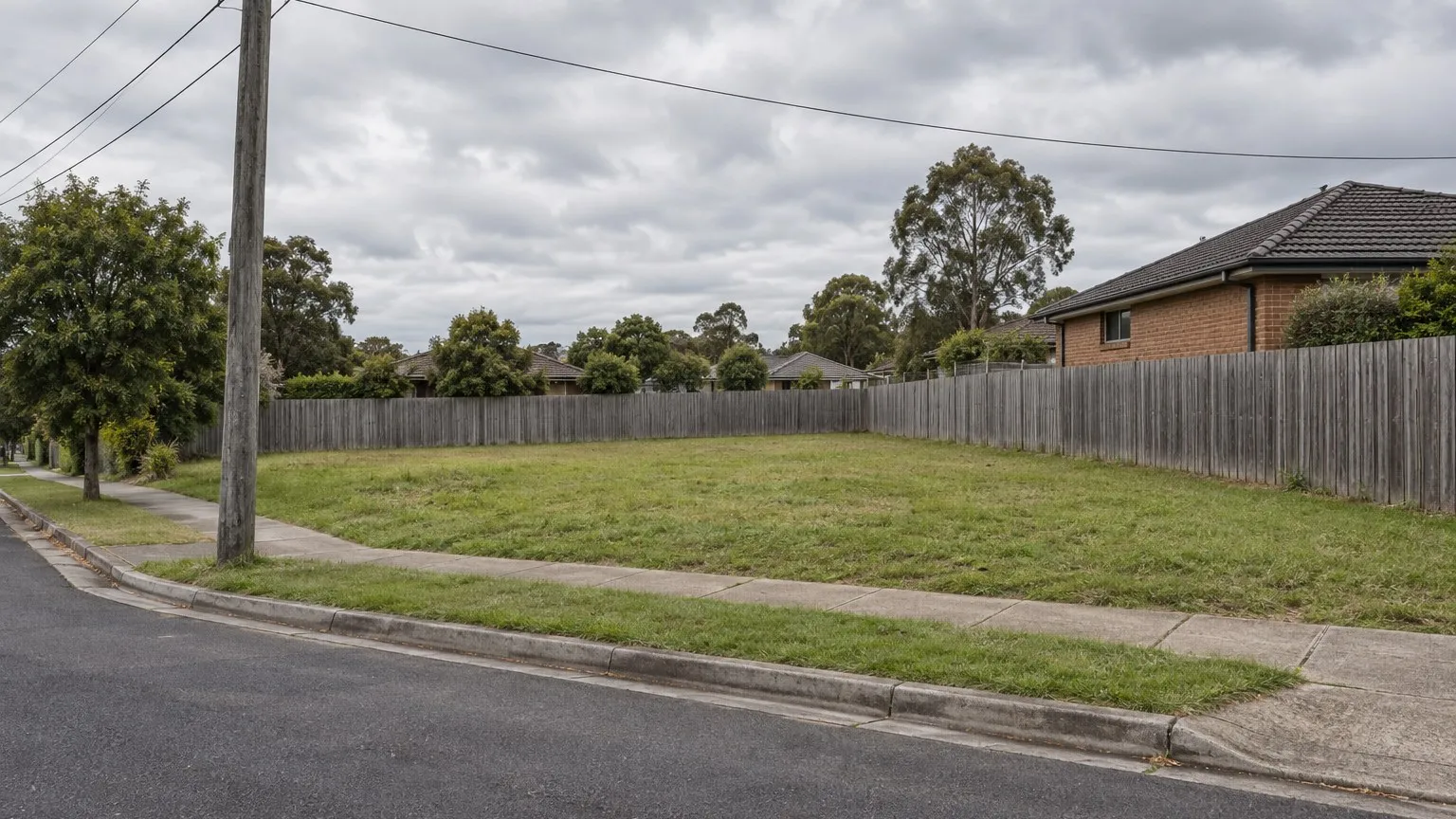
You have found a corner block that stacks up. Frontage works, the zoning allows three dwellings, the end values are there. Then your civil consultant sends a short email: check the supply capacity before you go too far.
On a small infill site in New South Wales, electricity supply is one of the quietest ways to lose a dwelling — or a year. It is not a service connection you order at the end. Under the state's own rules, if the distributor decides your load is too large to come off the street mains, you can be required to give up part of your land for its equipment, at no cost to the distributor. That land comes off your yield, and the restrictions follow the lots into sale.
The deal question: can the street actually supply what you want to build?
Most developers ask this far too late, usually when the builder applies for a connection. By then the scheme is approved, the yield is locked, and any answer other than “yes” is expensive.
The correct question at due diligence is narrower and more useful: what is the maximum demand of the scheme I am planning, and does the distributor's network have capacity to serve it from the existing street mains — or will it need a substation on my land?
The checks a student would run, in order
- Identify the distributor for the address. In New South Wales this is usually Ausgrid or Endeavour Energy. Their published requirements differ, and the difference matters.
- Understand the underlying rule. The Service and Installation Rules of New South Wales (April 2026) set the state-wide framework. Clause 1.12.10 states that where supply is too large for a low-voltage service, “the electricity distributor may require transformers, switchgear and other distribution equipment to be installed on the customer's premises” and “will, in such circumstances, require the customer to provide a place within the premises to accommodate the transformers, switchgear and other equipment free of cost”. That place must be suitable to the distributor, enclosed at the distributor's approval and no cost to it, and provided with satisfactory access and tenure.
- Get the distributor's number, not your own estimate. This is the step developers skip. Ausgrid's NS110 design standard for underground residential subdivisions states that the appropriate after-diversity maximum demand for a subdivision “shall be provided by Ausgrid”. You cannot size the supply yourself, and you cannot assume a dwelling count is a threshold.
- Test the load against the published trigger. Endeavour Energy's underground design instruction MDI 0028 states that for multi-dwelling developments in urban areas, at loads of 150 amps per phase or greater as assessed by Endeavour Energy, a padmount substation may be required on site. Ausgrid publishes no equivalent dwelling-count threshold; NS110 states that services larger than 400 amperes shall be supplied directly from the nearest substation, or “a kiosk substation may need to be constructed on site if network capacity is determined to be insufficient”.
- Test whether your site can physically host it. Endeavour's published padmount easement is 2.75 metres by 5.5 metres. Ausgrid's NS141 requires permanent on-title restrictions at the development stage, including a 3 metre fire restriction and a swimming pool restriction off-street for residential corner lots. It also requires crane access for installation, and NS141 states that off-street kiosk sites require an easement provided at the development stage “to minimise ongoing land title problems”.
- Confirm who pays, and when. Ausgrid states that where a connection requires the network to be extended or upgraded “you will be responsible for costs of network augmentation”, and its connection contract requires a capital contribution for augmentation of shared network, with ASP Level 3 design and ASP Level 1 construction. Endeavour's model standing offer for subdivision connection work requires the developer to engage accredited providers at its own cost.
- Check the title and plan consequences now, not later. Ausgrid requires the substation site to be covered by registered easements or a positive covenant where infrastructure crosses other lots, and its subdivision connection guidance explains that council will generally require a Notification of Arrangements confirming electricity supply has been planned and any required connection works are underway or completed.
And who pays is settled too. Ausgrid's connection contract guidance states that where shared parts of its network have to be augmented “you must make a capital contribution to the cost of the augmentation works”, requires an Accredited Service Provider Level 3 to design the changes and an ASP Level 1 to construct them, and notes Ausgrid becomes the owner of the infrastructure once it is electrified. Where the works are substantial — nominally over $1 million — and initially only benefit your development, Ausgrid may require a security fee under a Deed of Guarantee of Minimum Revenue.
The order, and why it is the whole lesson
Notice the progression: rule first, then the distributor's own number, then the load test, then the physical site test, then the money, then the title. That order is deliberate, because each step can eliminate the next.
If you brief an architect before you know whether a 2.75 by 5.5 metre easement and its restrictions will sit inside your site, you are designing a scheme you may not be able to service. If you let a builder price the project before the connection is confirmed, you are pricing a project whose scope is not settled. Ausgrid's own connection contract page and the Service and Installation Rules (clause 1.13.3) both warn against committing to designs, materials or works before written approval.
The student habit here is not “get a connection quote”. It is: settle the servicing envelope before the design envelope, because the servicing envelope is the one you cannot negotiate.
The trap: the site that loses a dwelling before anyone notices
Picture a 700 square metre corner block with a three-dwelling scheme. The architect fits three units, a driveway and landscaping, and the numbers work. Nobody has spoken to the distributor.
Six weeks into the design, the load assessment comes back requiring a padmount. Now the site must give up 2.75 by 5.5 metres for the padmount easement, keep a crane route to it, and carry a 3 metre fire restriction and a swimming pool restriction on title. On a site this size, that envelope plus the access requirement can be the difference between three dwellings and two.
The developer has not lost the deal to the market. They have lost it to a servicing constraint that was knowable before they made the offer.
Cost, timing and feasibility implications
- Yield. The servicing envelope, the easement and the on-title restrictions reduce what you can build. This is a hard constraint, not a cost you can buy out.
- Cost. The developer pays for design through an ASP Level 3, construction through an ASP Level 1, and the substation site preparation. Ausgrid's NS141 requires the developer to be responsible for “all substation site preparation ... and for all associated costs, including piers, retaining walls and excavation of rock”. Add capital contribution for network augmentation where required.
- Timing. Endeavour's published design review is 10 business days, with a 180-day window to commence after approval. Ausgrid requires a Notification of Arrangements before the plan is released. None of this is fatal, but all of it sits on the critical path between approval and title.
- Security. Ausgrid notes that where augmentation works are substantial — nominally over $1 million — and only benefit your development, it may require a security fee through a Deed of Guarantee of Minimum Revenue. That is a real cash consideration on larger schemes.
The honest feasibility conclusion is that electrical servicing is a go/no-go check on small infill, not a line item. Either the site can carry the equipment and restrictions, or the scheme must shrink.
The Think Property Club lesson
This is the clearest example of a check that belongs in due diligence rather than in construction. A capable student does not wait for the builder's connection application to discover a constraint. They ask the distributor directly, in writing, before the offer, and they design around a confirmed answer.
That is repeatable due diligence: identify the constraint, go to the authority that owns it, get it in writing, and let the answer shape the plan. Same method, different constraint, every time.
Your next actions before you make an offer
- Confirm which distributor serves the address.
- Lodge an enquiry or proposed method of supply and ask, in writing, whether the existing network can supply the scheme you are planning.
- Ask the distributor to confirm the maximum demand figure, and do not substitute your own.
- Test the site plan against the published equipment footprint and access requirements, including crane access.
- Check whether any on-title restrictions would burden lots you intend to sell.
- Price the design, construction and site preparation costs into the feasibility as a real number.
- Build the distributor's review time and the plan-release gate into your program before you set a settlement date.
Reader question: if your best scheme needed 2.75 by 5.5 metres of land for the distributor, would it still work? Find out before you buy, not after.
Sources and boundaries
Sources checked 23 September 2026. Jurisdiction and limits: New South Wales only, and specifically the Ausgrid and Endeavour Energy distribution areas; Essential Energy requirements were not examined. The Service and Installation Rules described are the April 2026 edition, which superseded the June 2025 edition. Distributor standards are revised periodically — Ausgrid's NS110 and NS141 and Endeavour Energy's design instructions are versioned documents — so the current revision must be confirmed for the specific address. The 150 amps per phase padmount trigger is published by Endeavour Energy and is assessed by it, not by the applicant. No energisation lead time in calendar days is published by either distributor, and the only published dollar threshold in these documents is the nominally $1 million security-fee trigger for Ausgrid augmentation works. Site-specific advice from the distributor and a qualified electrical consultant is required before relying on any of this.
- Service and Installation Rules of New South Wales, April 2026 (NSW Department of Climate Change, Energy, the Environment and Water) — clause 1.12.10 and clauses 1.13 to 1.13.3. Used for: that the distributor may require transformers and switchgear on the customer's premises, that the customer must provide a place free of cost with satisfactory access and tenure, and that customers should not commit to works before written approval (Checked 23 September 2026)
- Ausgrid — NS110 Design of Underground Residential Subdivisions (technical document library). Used for: that the after-diversity maximum demand is provided by Ausgrid rather than the developer, and that services larger than 400 amperes may require an on-site kiosk substation (Checked 23 September 2026)
- Ausgrid — Subdivisions (connection information). Used for: that council generally requires a Notification of Arrangements confirming supply has been planned and connection works are underway or complete before the plan is released (Checked 23 September 2026)
- Ausgrid — Your connection contract (fees, contracts and policies). Used for: that the developer is responsible for network augmentation costs and a capital contribution, that ASP Level 3 design and ASP Level 1 construction apply, and the security fee for substantial augmentation works (Checked 23 September 2026)
This article is general education, not personalised planning, legal, financial, tax, privacy, safety or building advice. Requirements and outcomes vary by jurisdiction, site, contract, structure and circumstances. Check current information with the relevant authority and appropriately qualified advisers.
 Learn with Jason & AmyBuild practical small-scale property development skills with experienced mentors.Enquire now
Rate this article
Guest rating: select 1 star for poor or 5 stars for great. No account is required.
Leave a comment
Join the discussion. Your email address will not be published.
Frequently asked questions
Can the distributor really require me to give up part of my own land?
Yes, if it decides your supply is too large to come off the low-voltage street mains. The Service and Installation Rules of New South Wales provide that the distributor may require transformers, switchgear and other distribution equipment on the customer's premises, and will require the customer to provide a place to accommodate them free of cost. That place must be suitable to the distributor, enclosed to its approval at no cost to it, and provided with satisfactory access and tenure. On small infill sites this is a yield issue, not just a cost.
How many dwellings trigger a substation requirement?
There is no single number, and that is the trap. Endeavour Energy's underground design standard MDI 0028 states that for multi-dwelling developments in urban areas, at loads of 150 amps per phase or greater as assessed by Endeavour Energy, a padmount substation may be required on site. Ausgrid publishes no equivalent dwelling-count threshold and states that the after-diversity maximum demand shall be provided by Ausgrid. Ask the distributor for the load figure rather than inferring one.
How much land does the equipment take, and can I hide it in the front yard?
Assume you cannot. Endeavour Energy's published padmount easement is 2.75 by 5.5 metres, plus crane access for installation. Ausgrid's NS141 requires permanent on-title restrictions at the development stage including a 3 metre fire restriction and a swimming pool restriction off-street for residential corner lots, and states that off-street kiosk site locations require an easement provided at the development stage to minimise ongoing land title problems. Ausgrid's standards also provide that footpath sites are not to be used where the need for the substation is created by a developer.
Who pays to design and build it?
The developer. Ausgrid states that if a connection requires the network to be extended or upgraded you are responsible for the costs of network augmentation, and its connection contract requires a capital contribution where shared network is augmented, with ASP Level 3 design and ASP Level 1 construction. Ausgrid's NS141 also makes the developer responsible for substation site preparation and all associated costs, including piers, retaining walls and rock excavation. Endeavour Energy's model standing offer requires the developer to engage accredited providers at its own cost.
What is the risk of ordering design work before the connection is confirmed?
A real one. The Service and Installation Rules advise that a person who wishes to connect or increase capacity must complete an application for connection, and that customers are advised not to make commitments or payments for designs, materials or works until they receive written approval. Signing a construction contract before the supply position is settled exposes you to both delay and sunk cost if the answer changes what you can build.
Loading comments…