

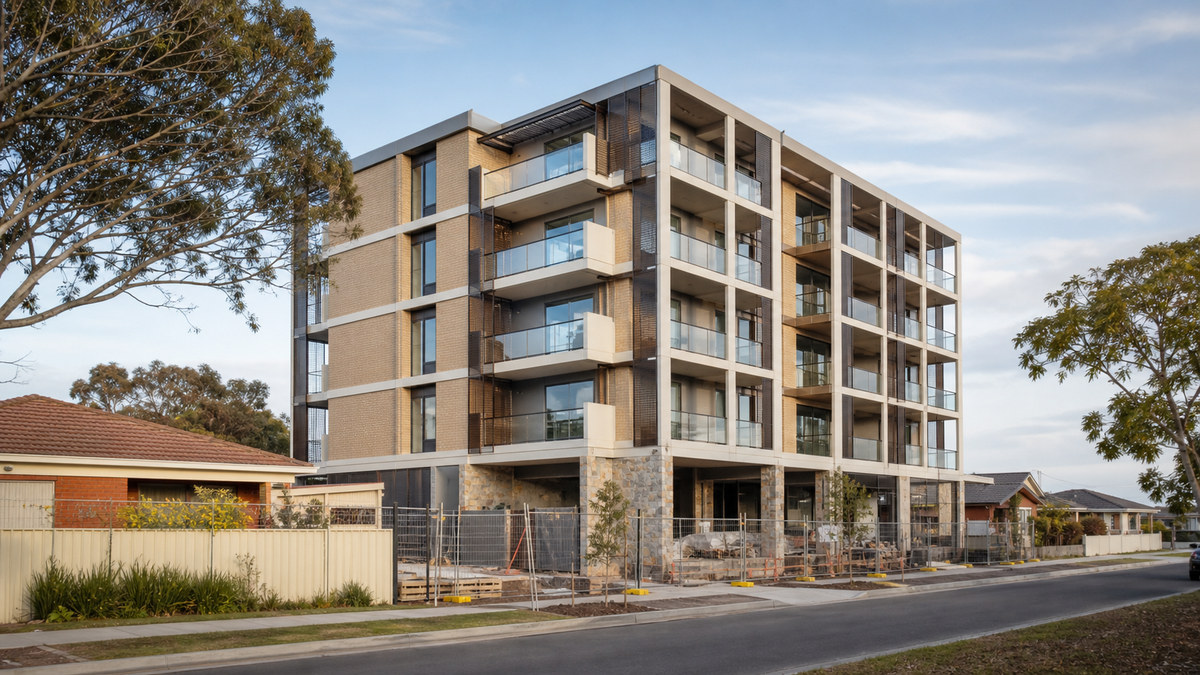
 Conceptual original editorial image generated for Think Property Club; not an official Warri Apartments rendering.
Renewal SA says construction has begun on 42 affordable rental apartments at Seaton in Adelaide’s western suburbs, while a neighbouring 22-apartment public-housing building approaches completion.
The five-storey, $20 million affordable project on Frederick Road is known as the Warri Apartments. Renewal SA says it will include one- and two-bedroom dwellings, with homes on the ground and first floors designed to meet disability accommodation requirements. Completion is expected by the end of 2027.
Affordability is part of the operating model
After completion, Renewal SA intends to appoint a community-housing provider to manage the building and lease the apartments to eligible tenants at 75 per cent of market rent. That is a defined tenure and management model, not simply a discounted sales campaign.
Analysis: For a developer, the distinction changes the feasibility. Revenue timing, valuation, finance covenants, operating costs and long-term maintenance responsibilities can differ materially between affordable rental housing, public housing and private dwellings for sale.
The project sits inside a larger sequence
The 42 apartments form part of a first stage totalling 138 homes. Renewal SA says the wider Seaton renewal will replace 388 ageing public homes one-for-one and deliver about 1,452 new private and public homes over a decade, with more than 20 per cent offered as affordable housing.
The adjacent four-storey public-housing project contains 22 two-bedroom apartments and is expected to finish by the end of 2026. Future apartment buildings are planned in later stages.
Analysis: Staging allows infrastructure, relocation, sales and construction activity to be sequenced, but it also creates interfaces between residents, building sites and successive delivery partners. The master feasibility needs to show which stage funds each shared asset and who carries unfinished precinct obligations if timing changes.
Funding affects the program
Renewal SA says the Warri Apartments are supported by the Housing Australia Future Fund Facility. That support is project-specific. A private proponent should not assume the same terms are available without an actual program approval and executed agreements.
Where concessional finance or government support is involved, the team should track eligibility, milestones, reporting, security and operating requirements alongside ordinary lender conditions. Missing a program milestone can affect cash flow even when construction itself is on schedule.
Seven questions for mixed-tenure renewal
- Which dwellings are private, affordable or public, and when can that mix change?
- Who owns and manages each building after completion?
- How are shared roads, landscapes, utilities and community spaces funded?
- What accessibility and energy-performance standards apply?
- How are existing residents protected and relocated through staging?
- What happens if one delivery partner or stage is delayed?
- Does the valuation method reflect the actual rent restrictions and operating model?
Density is not the whole renewal story
The program is transforming an area historically characterised by small dwellings on large blocks into a more diverse neighbourhood. Higher yield helps make better use of land, but the quality of streets, landscaping, parking, accessibility and the relationship between new apartments and existing homes will influence the result.
A five-storey building can be a sensible middle scale in an established suburb when transitions, privacy and public realm are resolved. Those details are not decorative. They affect approvals, community acceptance, tenant experience and long-term asset performance.
TPC deal lens
Developers looking at government-led renewal should underwrite the actual tenure and stage, not the total precinct headline. Confirm the revenue mechanism, funding conditions, shared-infrastructure obligations and operator requirements before assigning value to density.
Sources and image attribution
- Renewal SA — Apartment living reaching new heights at Seaton, posted 20 August and updated 21 August 2026; accessed 29 August 2026.
- Renewal SA and South Australian Housing Trust — Seaton project site, precinct scale and location; accessed 29 August 2026.
- Feature image: original conceptual editorial artwork generated for Think Property Club on 29 August 2026 using OpenAI image generation. No third-party source image was used. It is not an official project render; Think Property Club publication use authorised.
This article is general property education, not financial, legal, housing-allocation or planning advice. Verify current program documents and obtain qualified advice for the specific project.
Watch The Free Training
Learn the practical framework Jason and Amy use to assess property opportunities, risk and feasibility.
Register for Webinar Jam →Frequently asked questions
What should investors know about Affordability is part of the operating model?
After completion, Renewal SA intends to appoint a community-housing provider to manage the building and lease the apartments to eligible tenants at 75 per cent of market rent. That is a defined tenure and management model, not simply a discounted sales campaign.
What should investors know about The project sits inside a larger sequence?
The 42 apartments form part of a first stage totalling 138 homes. Renewal SA says the wider Seaton renewal will replace 388 ageing public homes one-for-one and deliver about 1,452 new private and public homes over a decade, with more than 20 per cent offered as affordable housing.
What should investors know about Funding affects the program?
Renewal SA says the Warri Apartments are supported by the Housing Australia Future Fund Facility. That support is project-specific. A private proponent should not assume the same terms are available without an actual program approval and executed agreements.
What should investors know about Density is not the whole renewal story?
The program is transforming an area historically characterised by small dwellings on large blocks into a more diverse neighbourhood. Higher yield helps make better use of land, but the quality of streets, landscaping, parking, accessibility and the relationship between new apartments and existing homes will influence the result.
What should investors know about TPC deal lens?
Developers looking at government-led renewal should underwrite the actual tenure and stage, not the total precinct headline. Confirm the revenue mechanism, funding conditions, shared-infrastructure obligations and operator requirements before assigning value to density.
Rate this article
How useful did you find this article? 1 is poor and 5 is great.
Join the conversation
Your email address will not be published.
Loading comments…