

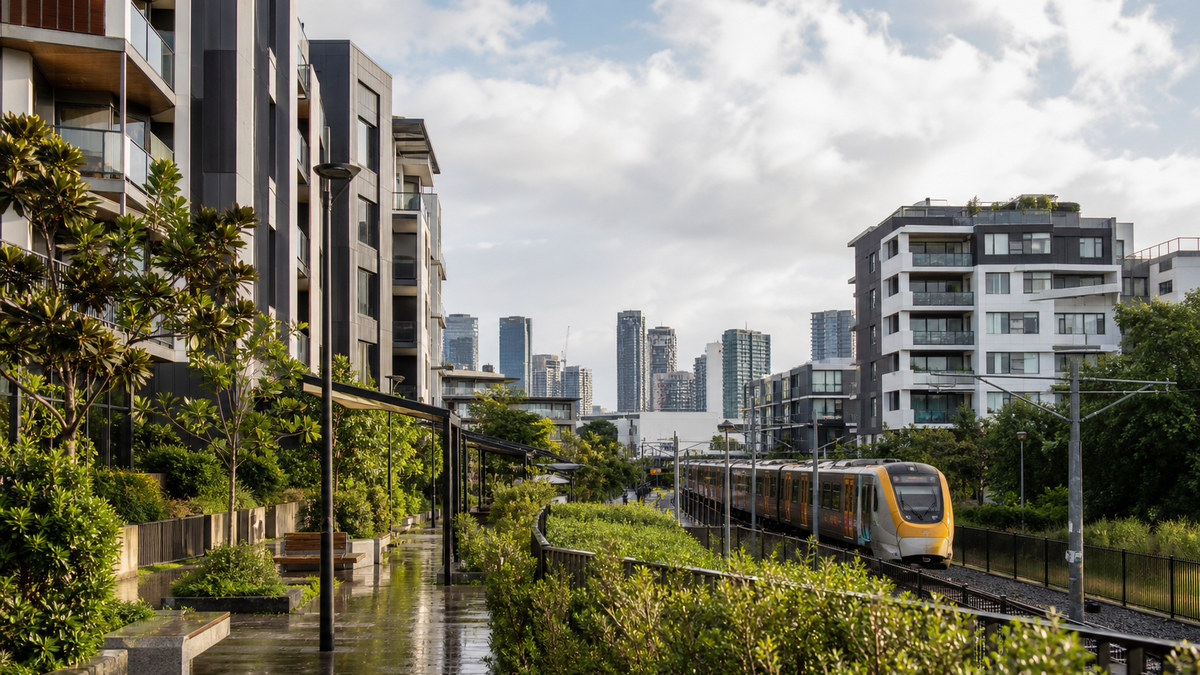
 Conceptual original editorial image generated for Think Property Club; not an official precinct rendering.
Queensland’s Land Activation Program for South East Queensland has moved from draft consultation to an operative provisional planning framework. Economic Development Queensland says the Provisional Land Use Plan took effect on 24 August 2026 across Banyo, Meadowbrook, Montague Road and Turbot Street.
The state describes the four precincts as a pathway to more than 5,000 homes and two mixed-use precincts. That figure is a program-level ambition, not an approval for 5,000 completed dwellings.
What changed on 24 August
The final plan now regulates development in the Provisional Priority Development Area. Economic Development Queensland is responsible for planning, infrastructure coordination and development assessment within the PPDA under the Economic Development Act 2012, while councils and state agencies continue to provide input.
The framework covers overall and precinct-specific outcomes, development criteria, assessment and infrastructure requirements. EDQ says the plan guides type, scale and form rather than detailed building design. Detailed proposals still need assessment against the plan and other relevant requirements.
Four precincts, four different tests
Banyo’s 56 Blinzinger Road site is identified for about 400 homes. The 35,480-square-metre Meadowbrook site at 35 University Drive is intended for medium-density residential development. Montague Road is framed as a mixed-use destination with housing, culture and public realm, while the Turbot Street sites are intended for high-density urban development that responds to heritage, cultural values and parkland interfaces.
Analysis: A single regulatory umbrella does not make these sites interchangeable. Banyo and Meadowbrook require product and absorption testing suited to their local markets. Montague Road carries public-realm and connectivity questions. Turbot Street requires careful interface work with heritage and parkland. The feasibility drivers differ even when the policy mechanism is shared.
The plan reduces ambiguity, not risk
EDQ states that traffic, infrastructure and flood modelling are undertaken at development-application stage. That is a reminder that a strategic framework does not settle civil capacity, remediation, access, staging or the final cost of public works.
Affordable-housing opportunities are also to be considered through later development processes, partnerships and procurement. Developers should not invent a percentage, tenure structure or subsidy assumption before the relevant procurement and project documents are published.
Six documents to build before bidding
- A clause-by-clause matrix showing how the concept responds to the final land-use plan.
- An infrastructure responsibility schedule separating existing, government-funded and developer-funded works.
- A site-constraint register covering flooding, contamination, heritage, access and adjoining uses.
- A market study tailored to the proposed housing mix and staging rate.
- A procurement assumptions register identifying every item not yet confirmed.
- A downside feasibility that allows for longer approvals, higher civil costs and slower sales or leasing.
Consultation is complete, delivery is not
The draft plan was exhibited from 1 to 19 June. EDQ reports that submissions were reviewed and that the final plan added provisions for PDA-associated development in the Montague Road precinct to better coordinate public realm, connectivity and infrastructure.
The PPDA is an interim planning stage that generally operates for up to three years. Future development proposals will be assessed, and the state says further community updates will follow. A developer should therefore track both the operative plan and the transition to any permanent planning framework.
TPC deal lens
The opportunity is not simply “government land near transport”. Value will be created by converting a broad policy direction into a deliverable precinct sequence: first infrastructure, then product, then finance, then absorption. Treat the 5,000-home figure as context; price the parcel and stage that can actually be delivered.
Sources and image attribution
- Economic Development Queensland — Land Activation Program (SEQ Tranche 1) PPDA, including final plan status, precinct summaries and FAQs; accessed 29 August 2026.
- Economic Development Queensland — Final Provisional Land Use Plan, effective 24 August 2026; accessed 29 August 2026.
- Feature image: original conceptual editorial artwork generated for Think Property Club on 29 August 2026 using OpenAI image generation. No third-party source image was used. It is not an official precinct render; Think Property Club publication use authorised.
This article is general property education, not financial, legal or planning advice. Check the final statutory documents and obtain qualified site-specific advice.
Watch The Free Training
Learn the practical framework Jason and Amy use to assess property opportunities, risk and feasibility.
Register for Webinar Jam →Frequently asked questions
What should investors know about What changed on 24 August?
The final plan now regulates development in the Provisional Priority Development Area. Economic Development Queensland is responsible for planning, infrastructure coordination and development assessment within the PPDA under the Economic Development Act 2012, while councils and state agencies continue to provide input.
What should investors know about Four precincts, four different tests?
Banyo’s 56 Blinzinger Road site is identified for about 400 homes. The 35,480-square-metre Meadowbrook site at 35 University Drive is intended for medium-density residential development. Montague Road is framed as a mixed-use destination with housing, culture and public realm, while the Turbot Street sites are intended for high-density urban development that responds to heritage, cultural values and parkland interfaces.
What should investors know about The plan reduces ambiguity, not risk?
EDQ states that traffic, infrastructure and flood modelling are undertaken at development-application stage. That is a reminder that a strategic framework does not settle civil capacity, remediation, access, staging or the final cost of public works.
What should investors know about Consultation is complete, delivery is not?
The draft plan was exhibited from 1 to 19 June. EDQ reports that submissions were reviewed and that the final plan added provisions for PDA-associated development in the Montague Road precinct to better coordinate public realm, connectivity and infrastructure.
What should investors know about TPC deal lens?
The opportunity is not simply “government land near transport”. Value will be created by converting a broad policy direction into a deliverable precinct sequence: first infrastructure, then product, then finance, then absorption. Treat the 5,000-home figure as context; price the parcel and stage that can actually be delivered.
Rate this article
How useful did you find this article? 1 is poor and 5 is great.
Join the conversation
Your email address will not be published.
Loading comments…