
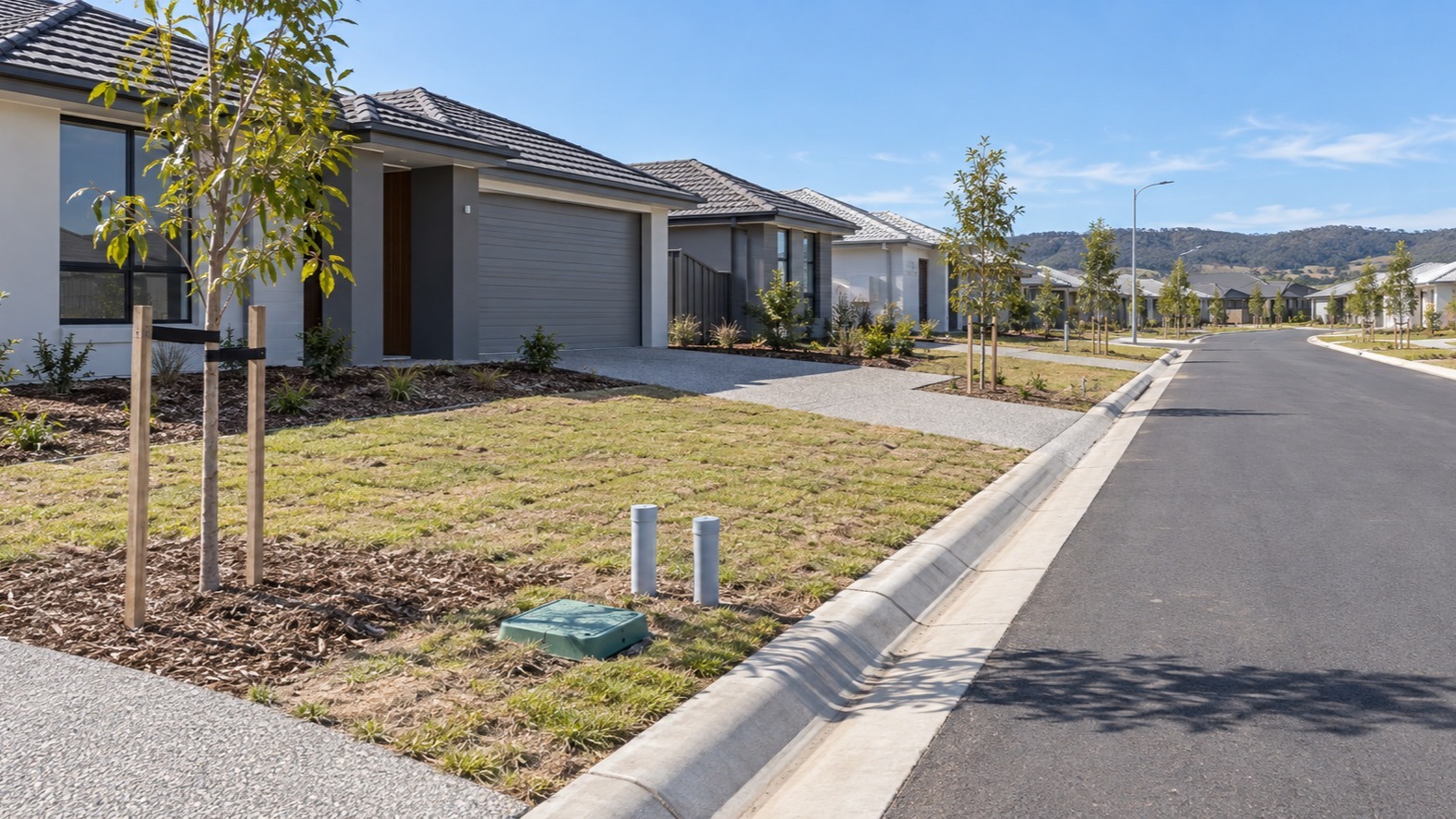
New Developments: The pit is the cheapest part of the connection
Two developers can build identical duplexes side by side and end up with different telecommunications costs, because the charge is per lot and the pathway depends on how the site is serviced. Most first-time developers find this out from a supplier invoice rather than from their own feasibility. That is an avoidable way to lose margin on a small project.
The deal question: what must I build, and who pays?
The starting point is that telecommunications infrastructure in a new development is the developer's responsibility. The Australian Government's Telecommunications Infrastructure in New Developments policy sets the framework: developers are responsible for organising and meeting the cost of fibre-ready facilities such as conduits and pit and pipe for every new building, unit or lot, and for organising and contributing to the cost of the phone and internet infrastructure.
You can choose the carrier. NBN Co is the default statutory infrastructure provider, and under the SIP regime whichever carrier installs the network for your development becomes the provider for it, with an obligation to connect premises and supply wholesale broadband.
The numbers you can actually verify
nbn publishes the caps it operates under. The maximum developer deployment contribution is $600 per single dwelling unit lot or premises including GST, and $400 per multi dwelling unit premises. Where a wireless or satellite solution is required the caps are higher. An end-user contribution of up to $300 per premises may also be charged, generally recovered from the first retail provider to order a service.
Backhaul is the line item that surprises people. Where nbn backhaul to your development is not already available, the developer can be charged up to 50% of the first $1,000 per lot of backhaul cost and up to 100% of the cost above $1,000 per lot. On a greenfield estate some distance from existing infrastructure, that is the number that moves a feasibility.
Which pathway applies to your site
nbn's design and build guidelines set out three options. Lead-in conduits suit 1 to 8 premises facing an existing road with no private roads. Pit and pipe — conduits installed underground into shared local network pits — is the typical build for multiple premises or where new private or public roads are being constructed. Pathways are for in-building distribution in high-rise and commercial buildings.
So a four-lot battle-axe subdivision and a 40-lot estate attract different scopes of civil work, different inspection obligations and different per-lot contributions, even though the headline cap looks the same.
The trap: treating it as a supplier's problem
Under the pit-and-pipe pathway the developer has to design the works to nbn's guidelines, upload a pre-construct design for acceptance, build to the approved design, and then lodge as-built designs and a Notice of Practical Completion. nbn inspects and accepts the works before issuing a Certificate of Practical Completion and arranging the network installation.
If you leave that until after your civil contractor has demobilised, you are paying a second mobilisation and you are holding up settlements. And if the pre-construct design is accepted late, the works get built twice or not at all.
How a student would test it on a real site
- Confirm the carrier and the pathway from the development type: number of lots, whether new roads are being built, and whether the lots face an existing road.
- Get a written per-lot contribution figure and a backhaul assessment, not a verbal estimate.
- Split the cost into civil works, carrier contributions and any end-user contribution that lands on you.
- Put the pre-construct design and the as-built acceptance into the civil program, not after it.
- Check what the buyer is promised in the contract of sale and when services will actually be available.
The TPC lesson here is sequencing. This is a services cost, and like every services cost it has to be in the feasibility before you know your offer, not discovered at practical completion.
Practical next steps
- Submit a New Development Application to your chosen carrier early for a detailed cost assessment including backhaul.
- Include the pre-construct design, inspection and as-built steps in the civil program and the contract.
- Carry the maximum contribution per lot in the base case and the actual quoted figure as the expected outcome.
- Confirm who pays the end-user contribution on each lot.
- Record the carrier, the pathway and the acceptance dates in your project decision log.
Sources and boundaries
Sources checked 21 September 2026. Jurisdiction and limits: Australia-wide policy framework (the Commonwealth TIND policy and the ACMA SIP regime), with the contribution caps and build pathways as published by nbn as at the checked date. Caps, thresholds and nbn's commercial arrangements change; carriers other than nbn have their own charges and designs. The applicable pathway, contribution amounts and backhaul exposure for any specific development can only be confirmed by a New Development Application and a written assessment from the carrier.
- nbn — government policy for new developments (TIND policy, developer contributions and caps). Used for: the developer's responsibility for fibre-ready facilities, the maximum deployment contributions of $600 per SDU and $400 per MDU, wireless/satellite contributions, backhaul contribution caps and the end-user contribution of up to $300 (Checked 21 September 2026)
- Australian Government — telecommunications in new developments (TIND policy and the SIP regime). Used for: the developer's obligation to provide telecommunications infrastructure, the 1 September 2020 TIND policy, and NBN Co as the default statutory infrastructure provider (Checked 21 September 2026)
- nbn — design and build guidelines (lead-in conduit, pit and pipe, and pathways options). Used for: which build pathway applies: lead-in conduits for 1 to 8 premises facing an existing road, pit and pipe for multiple premises or new roads, and pathways for in-building services (Checked 21 September 2026)
- nbn — pit and pipe (developer design, pre-construct and as-built obligations). Used for: the developer's design, pre-construct upload, as-built and Notice of Practical Completion obligations, and nbn's acceptance and practical completion steps (Checked 21 September 2026)
- ACMA — statutory infrastructure provider regime (SIP obligations and the SIP register). Used for: that NBN Co is the default SIP, that other carriers can be SIPs for new developments, and the SIP obligation to connect premises and supply wholesale broadband (Checked 21 September 2026)
This article is general education, not personalised planning, legal, financial, tax, privacy, safety or building advice. Requirements and outcomes vary by jurisdiction, site, contract, structure and circumstances. Check current information with the relevant authority and appropriately qualified advisers.
 Learn with Jason & AmyBuild practical small-scale property development skills with experienced mentors.Enquire now
Rate this article
Guest rating: select 1 star for poor or 5 stars for great. No account is required.
Leave a comment
Join the discussion. Your email address will not be published.
Frequently asked questions
How much does the carrier charge me per lot?
Under the TIND policy the maximum developer deployment contribution is $600 per single dwelling unit lot or premises and $400 per multi dwelling unit premises, both including GST, with higher caps where a wireless or satellite solution is required. nbn can charge below those caps. Backhaul contributions are separate and can add up to half of the first $1,000 per lot of backhaul cost and all of the cost above $1,000 per lot, where backhaul is not already available.
Whose responsibility is the pit and pipe work?
The developer's. Under the TIND policy developers are responsible for organising and meeting the cost of fibre-ready facilities such as conduits and pit and pipe for every new building, unit or lot, and for organising and contributing to the cost of the phone and internet infrastructure. In practice that means designing the works to the carrier's guidelines, uploading a pre-construct design for acceptance, building to the approved design, and then providing as-built designs and a Notice of Practical Completion.
Do I need pit and pipe, or is a lead-in conduit enough?
It depends on the shape of the development. nbn's design and build guidelines describe lead-in conduits as typical for 1 to 8 premises facing an existing road with no private roads, while pit and pipe — conduits into shared local network pits — is the typical pathway where there are multiple premises, new private or public roads to be built, super lots or empty lots accessed by a new road. A small duplex conversion and a 40-lot subdivision are not the same problem.
When does this money have to be spent?
Earlier than most first-time developers expect. The pit-and-pipe works are constructed as part of your civil works and must be inspected and accepted before practical completion, and the connection box is ideally pre-installed at frame stage. If infrastructure is not in place when buyers settle, they face delays and extra costs getting services connected, which becomes your problem at handover.
Can I choose a carrier other than nbn?
Yes. Developers can choose the carrier that services their development, and where a carrier other than NBN Co is contracted the carrier becomes the statutory infrastructure provider for that development. NBN Co is the default statutory infrastructure provider, and it remains the infrastructure provider of last resort for larger developments within its fixed-line footprint. Whoever you use, the fibre-ready facilities obligation stays with you.
Loading comments…