
NSW Water Assets: Check where the main runs before you draw anything
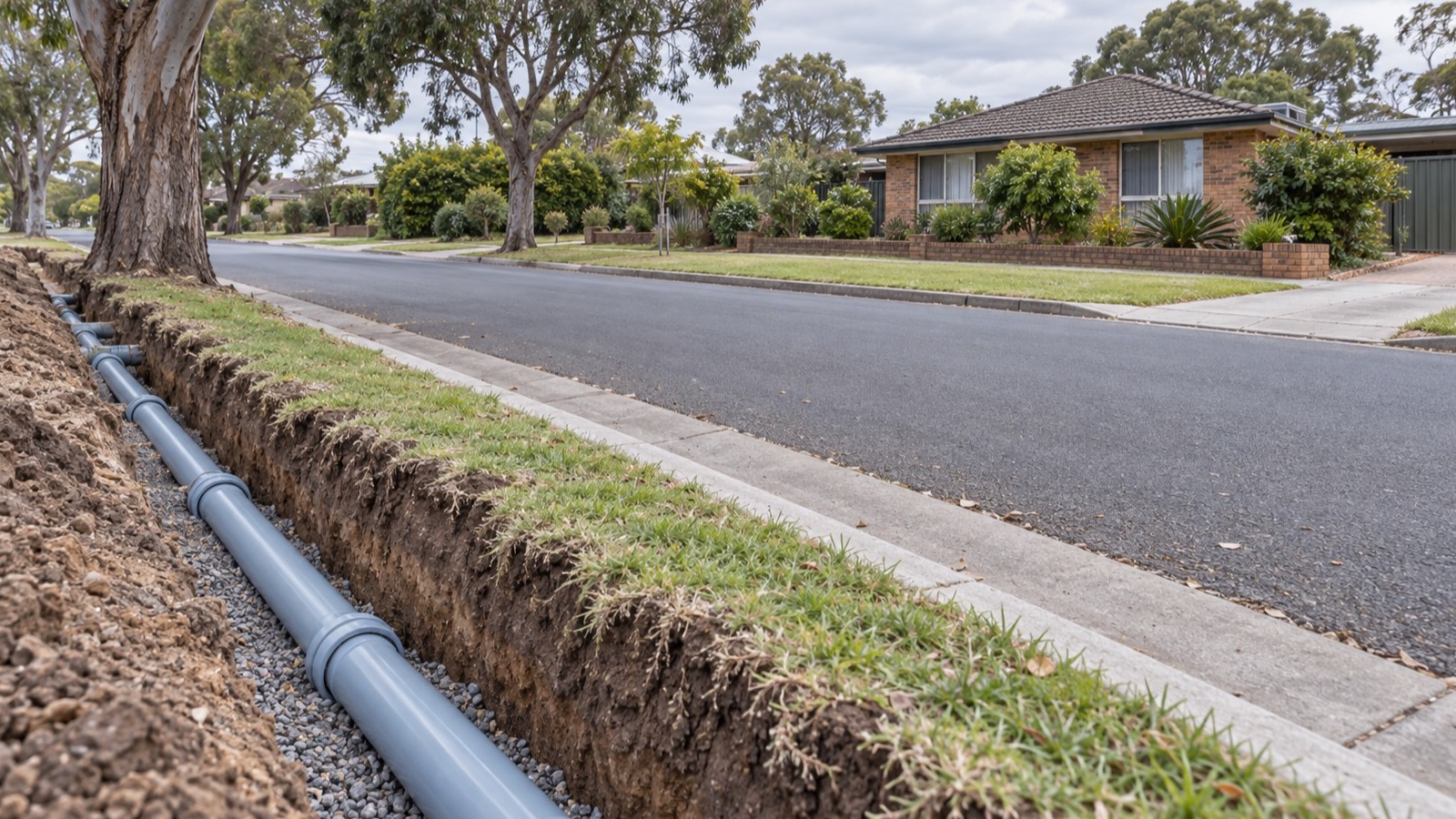
The first expensive mistake on an infill site is usually not a planning rule. It is a pipe. On a typical suburban block the sewer main runs through the middle of the land, close to a side boundary or along the rear, and the part of the site you designed your dwellings around is exactly where the asset sits. If you have already paid for a concept, engineering and a BASIX assessment when you discover that, you pay for all of it twice.
The deal question: can I actually build where I want to build?
Before the question is what the zoning permits, it is what the ground will allow. In New South Wales, Sydney Water must assess and approve your building plans before work starts, and it is blunt about the consequence: if a development application is needed for building work, the DA will not be consented unless Sydney Water has approved your building plans, and without a DA you cannot obtain the construction certificate. Approval to build or excavate near water, wastewater and stormwater assets is a separate requirement again.
That changes the sequence of your due diligence. The asset position is not a construction detail you resolve after the plans are drawn. It is an input into what you draw.
What can go wrong — and what it costs
The first failure mode is a dwelling sited over a main. Sydney Water will consider allowing certain structures over reticulation sewers with diameters of 300 mm and smaller, but it does not allow permanent structures over sewers larger than 750 mm without a specialist engineering assessment, and building over a wastewater maintenance structure is not permitted. Its technical guidelines for building over and adjacent to pipe assets also require free and full 24-hour access for operation and maintenance, which rules out walls, retaining structures, pits and landscaping in the wrong place.
The second is access. If your built form blocks the machine that reaches a surface fitting, you are funding an alternative access arrangement that Sydney Water must agree to.
The third is damage. The land development guide is direct that concrete entering sewer assets — most often during excavation and piering — is the primary cause of damage, and that you may be liable for repair costs. That is a construction-phase risk you carry long after the approval is settled.
What the process actually means for your program
Where there is no impact on the assets, approval comes back quickly through Sydney Water Tap in. Where there is an impact, the application is referred to a water servicing coordinator, and if the coordinator has to send it to Sydney Water as an out-of-scope application, Sydney Water says it generally sends its conditions of approval within 42 days for a non-complex review. That is the number to put in your program before you commit to a construction start.
There is also a servicing overlay on many infill projects: a Section 73 Compliance Certificate, which requires, among other things, a wastewater connection point at least one metre inside each lot boundary. A Notice of Requirements may be issued, and once it is, you have 12 months to meet it before you must reapply and pay again.
How I would assess it on a real site
A student working this deal would not start with the zoning map. They would start with the asset map, and in this order:
- Pull the service location print and sewerage service diagram for the address and mark the main, the maintenance structures and the connection point on a scaled plan.
- Walk the block and confirm the alignment; have the line pegged before any excavation.
- Draw the worst-case building envelope — the area that clears the asset, the access strip and any easement — and see whether your intended yield still fits.
- Decide whether the proposal triggers referral: a basement, dewatering, building over or adjacent to an asset, a pressure wastewater pipe, or any easement within the boundary.
- Budget the referral. If a specialist engineering assessment is required, it needs an engineer meeting Sydney Water's competency standard, and some submissions require independent verification.
If step three kills a dwelling, the deal is not dead — but the price should change, because your yield, your access and your construction method have all changed.
Cost, timing and feasibility
Price the asset test as a line item rather than an overhead. It is a service diagram, a location, possibly a survey, a water servicing coordinator, a specialist engineering assessment and then supervision of concrete encasement or piering if the design calls for it. Against that, a redesign that removes a dwelling is worth far more than the report. Work out which one you are buying before you sign.
Practical next steps
- Order the service location diagram and sewerage service diagram before your first concept sketch.
- Peg the asset on site and photograph the alignment against the boundaries.
- Overlay your maximum-yield envelope on the asset plan and note where it fails.
- Lodge the building plan approval application early, while the DA is being prepared — it can run in parallel.
- Confirm in writing whether the proposal will be referred, and put the 42-day review period and the 12-month Notice of Requirements clock in the program.
Sources and boundaries
Sources checked 21 September 2026. Jurisdiction and limits: New South Wales only, and only for land serviced by Sydney Water. The approval requirements, referral triggers, access rules and timeframes described are those published by Sydney Water for building plan approvals, building over or adjacent to pipe assets, and the land development process, and are stated as at the checked date. Other water utilities and other states and territories have their own asset protection regimes. A site-specific assessment by a water servicing coordinator and, where required, a specialist engineering assessment determines what applies to any particular block.
- Sydney Water — building plan approvals (approval required before work starts; DA cannot be consented without it). Used for: the approval requirement, the plans that must be referred to Sydney Water, and the 42-day indicative time for a non-complex out-of-scope review (Checked 21 September 2026)
- Sydney Water — technical guidelines: building over and adjacent to pipe assets (ACDP0254). Used for: the rules on reticulation sewers 300 mm and smaller, the prohibition on building permanently over sewers larger than 750 mm, access requirements and plant loading limits (Checked 21 September 2026)
- Sydney Water — building over or next to assets (approval required before you build or excavate). Used for: the approval obligation for building and excavation near water, wastewater and stormwater assets (Checked 21 September 2026)
- Sydney Water — land development guide (building plan approval, Notice of Requirements and Section 73 process). Used for: the 12-month period to meet a Notice of Requirements, the concrete-in-sewer damage risk from piering, and what a Section 73 Certificate confirms (Checked 21 September 2026)
- Sydney Water — steps for first-time developers (servicing, contributions and conditional building plan approval). Used for: the requirement for a wastewater connection point at least 1 m inside each lot boundary and the conditional approval pathway (Checked 21 September 2026)
This article is general education, not personalised planning, legal, financial, tax, privacy, safety or building advice. Requirements and outcomes vary by jurisdiction, site, contract, structure and circumstances. Check current information with the relevant authority and appropriately qualified advisers.
 Learn with Jason & AmyBuild practical small-scale property development skills with experienced mentors.Enquire now
Rate this article
Guest rating: select 1 star for poor or 5 stars for great. No account is required.
Leave a comment
Join the discussion. Your email address will not be published.
Frequently asked questions
Do I really need Sydney Water to approve my building plans before council consents to my DA?
Yes, for building work that affects Sydney Water assets. Sydney Water states that a development application will not be consented unless it has approved the building plans, and without a DA you cannot obtain a construction certificate. Lodging the building plan approval application while you prepare the DA is allowed and is the practical way to avoid a resubmission.
How do I find out where the sewer main actually is?
Start with a service location print or sewerage service diagram through Sydney Water Tap in or a Property Link broker, then have the line physically located and pegged on site before any excavation. The diagram shows the asset in relation to the boundary and the connection point; the peg-out is what tells you the depth and the real alignment when you are standing on the block.
Can I build over a sewer main?
Sometimes, but the rule is narrow. Under the technical guidelines Sydney Water will consider allowing certain structures over reticulation sewers of 300 mm diameter and smaller, subject to access and loading conditions, and it does not allow permanent structures over sewers larger than 750 mm without a specialist engineering assessment. Building over a wastewater maintenance structure is not permitted.
What does a basement or piering do to the assessment?
It moves the application out of the simple path. Basements, excavation, dewatering and building over or adjacent to assets must be referred to Sydney Water, and a specialist engineering assessment prepared by an engineer meeting its competency standard may be required. Concrete entering a sewer during piering is the most common cause of damage, and the cost of restoring the asset sits with the party that caused it.
How long do I have to act on a Notice of Requirements?
Twelve months. If the requirements are not met within that period you must submit a new application and pay another application fee, which resets the clock and the cost. Diarise the date the notice is issued, not the date you first saw it.
Loading comments…